
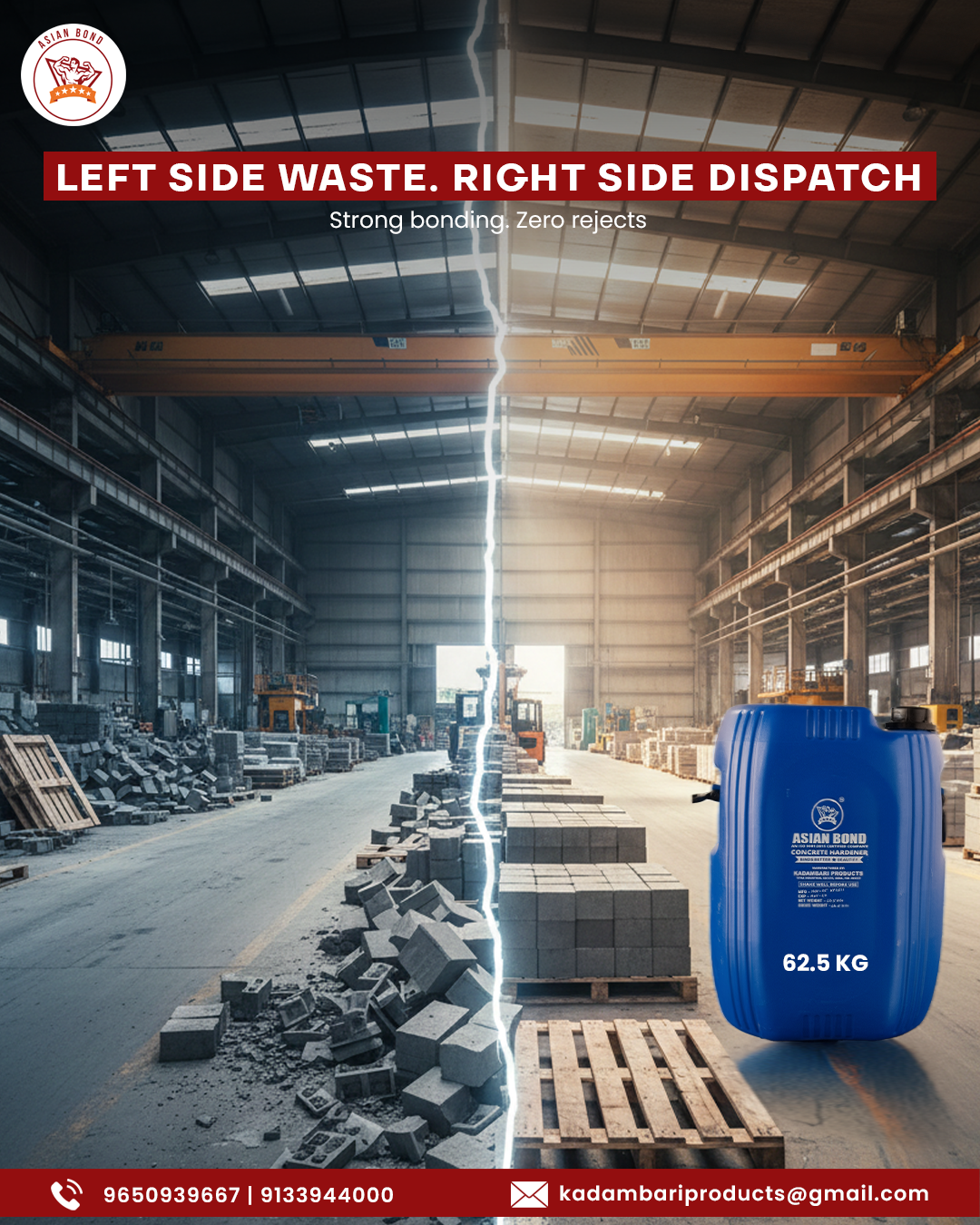
Concrete Hardener Helps Concrete Floors Last Longer
Concrete floors take daily abuse where machines roll, loads drag, and foot traffic never stops. When left untreated, surfaces begin to crack, shed dust, and form rough patches that demand constant repair. A liquid concrete hardener changes that trajectory. By penetrating deep into the slab, it restructures the material from within, extending service life and reducing maintenance costs over time.
Concrete Hardener Helps Concrete Floors Last Longer
Concrete floors take daily abuse where machines roll, loads drag, and foot traffic never stops. When left untreated, surfaces begin to crack, shed dust, and form rough patches that demand constant repair. A liquid concrete hardener changes that trajectory. By penetrating deep into the slab, it restructures the material from within, extending service life and reducing maintenance costs over time.
Products such as those developed by Asianbond set a high benchmark in India, delivering long-term protection that slows surface aging while preserving structural integrity. This guide explains how concrete hardeners work, why they matter, and how to choose the right solution when durability, local availability, or bulk purchasing are priorities.
Concrete Hardener Explained – Importance and Overview
Concrete hardener is a penetrating liquid that works on both new and aged slabs. Once applied, silicates react with calcium hydroxide inside the concrete to form calcium silicate hydrate (CSH). These microscopic crystals weave through pores and capillaries, increasing density and surface hardness.
Untreated concrete degrades quickly under abrasion, impact, and chemical exposure. Industrial floor hardeners prevent crumbling, crater formation, and dusting—often doubling or tripling service life. Asianbond’s formulation penetrates close to four millimeters below the surface, providing reinforcement exactly where heavy equipment exerts pressure.
Unlike topical sealers that remain on the surface, chemical hardeners bond internally. This stops dust permanently, resists spills, and improves load-bearing capacity—making them especially valuable in factories and warehouses.
The Science Behind How Concrete Hardeners Improve Durability
Moisture entering untreated concrete slowly weakens it. A liquid hardener fills internal voids and reacts chemically to create insoluble crystalline structures. These block pathways that allow water, oils, or chemicals to penetrate. With fewer open pores, freeze–thaw damage and chemical attack reduce dramatically.
Studies show treated floors withstand three to five times more wear than bare concrete. Asianbond uses lithium silicate chemistry, which reacts faster and penetrates deeper than traditional alternatives, improving compressive strength by approximately eight percent. This performance places it among India’s leading concrete admixture solutions.
How Concrete Hardener Extends Floor Life
- Eliminates surface dust, improving air quality in workspaces
- Resists abrasion from heavy wheels and continuous traffic
- Protects against oil, acid, and chemical spills
- Prevents recurring resurfacing cycles, saving long-term costs
- Preserves paver block color by preventing efflorescence
Asianbond maintains competitive pricing for bulk orders, and users consistently report floors lasting significantly longer than those treated with generic alternatives. Durability improvements of roughly 40 percent are commonly observed after extended use.
Concrete Hardener Types and Project Matching
Concrete hardeners vary by chemistry and depth of penetration:
- Entry-level sodium silicate options for light-traffic areas
- Potassium silicate for reduced residue and cleaner finishes
- Lithium silicate for deep penetration and high durability
Asianbond specializes in lithium-based formulations, offering high-performance solutions for factory floors, paver blocks, and brickwork. Their products are backed by long-term performance guarantees.
Applying Concrete Hardener for Maximum Floor Life
- Grind or shot-blast the surface to open pores
- Vacuum thoroughly to remove all dust and debris
- Dilute as recommended (typically 1:4 for brick applications)
- Apply evenly using sprayer or roller
- Apply a second coat in high-wear zones if required
- Keep surface lightly misted for the first 48 hours
- Allow three days before full traffic
- Polish to achieve a smooth, reflective finish
Applying hardener immediately after final troweling prevents dust formation from day one. Choosing verified suppliers such as Asianbond ensures consistent chemistry and avoids counterfeit materials.
Concrete Hardener for Paver Blocks and Outdoor Surfaces
Outdoor paving blocks deteriorate quickly when exposed to rain, UV radiation, and foot traffic. Concrete hardener seals each block, blocking moisture ingress and slowing color fade. Instead of failing within a few seasons, treated pavers maintain strength and appearance for years.
Applied before or after laying, Asianbond concrete hardener locks microcracks, repels water, and extends outdoor surface life by up to three times—especially valuable during India’s monsoon cycles.
Asianbond Concrete Hardener in India
Asianbond leads the Indian market for concrete hardeners engineered for harsh conditions. Its low-VOC, eco-conscious formulations perform reliably in dust-heavy construction zones, humid factories, and high-traffic urban environments.
- Eco-friendly, low-VOC formulation
- Available in bulk for large projects
- Nationwide distribution network
- Proven performance across thousands of sites
Pricing typically ranges from ₹155 to ₹245 per liter, with lower per-unit costs available for bulk procurement. Independent tests show Asianbond hardeners outperform generic products by nearly 50 percent in densification efficiency.
Floor Hardener Chemical Performance in Factories
In a Gujarat manufacturing facility, Asianbond hardener eliminated dust entirely while supporting machinery loads exceeding 50 tons. Fifteen years later, the surface remains intact without repairs.
A pharmaceutical plant in Hyderabad achieved spill-resistant flooring across 10,000 square meters, extending floor life by more than 25 years and saving an estimated ₹50 lakh in maintenance costs.
Buying Tips and Long-Term Value
For projects exceeding 500 square meters, bulk purchasing offers clear advantages. Asianbond supplies 200-liter drums at approximately 20 percent below standard market pricing.
- Verify ISO and ASTM compliance
- Check shelf life (typically two years)
- Test sample batches when evaluating suppliers
Treating 1,000 square meters at 0.2 liters per square meter may cost around ₹40,000, yet can prevent resurfacing expenses exceeding ₹2 lakh over the same period. Long-term value consistently outweighs upfront cost.
Liquid Concrete Hardener for Bricks
Liquid hardeners work effectively on brick and stone masonry, sealing pores to prevent efflorescence and surface weakening. Asianbond’s solution bonds well with both clay and concrete bricks, making it suitable for walls, paving units, and hybrid surfaces.
Final Thoughts
In India’s demanding environments, skipping concrete hardener is no longer practical. Heavy use, weather extremes, and chemical exposure require deeper protection than surface coatings can offer. Asianbond delivers one of the most reliable hardening solutions available, improving strength, reducing maintenance, and extending floor life substantially.
Stronger floors begin with informed decisions—selecting proven chemistry, sourcing from trusted suppliers, and applying treatments correctly. Over time, the benefits show clearly in durability, safety, and cost savings.